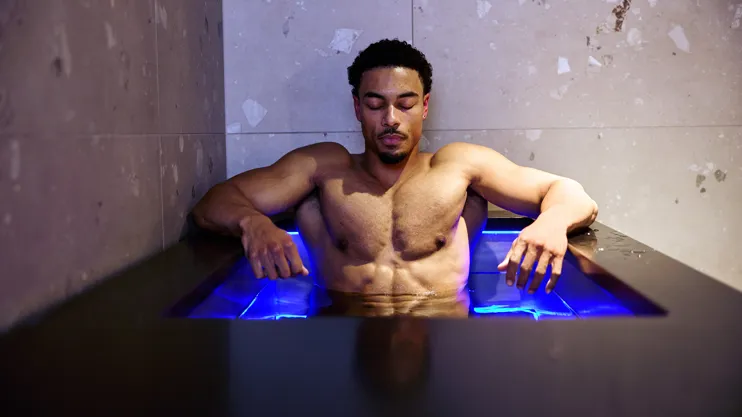
Take a deep-dive on cold water therapy?
It’s safe to say that few wellbeing trends have divided opinion quite like the cold plunge.
A long-standing staple of the athletic elite and beloved by wellness gurus, the concept of cold plunging has increasingly spilled into our social media feeds in recent years. Which may account for both the rise in popularity – and scepticism – around cold plunge benefits.
The truth is that the science behind it is a lot more nuanced than you might think. Much of its efficacy depends – and knowing the difference between what a cold plunge can do vs what they’re claimed to do is a major part of whether they’ll work for you.
Influencer hype? Partial hypothermia? Or something that can genuinely boost your health and wellbeing?
We’ll let you be the judge.
What is a cold plunge?
First, the basics. A cold plunge, also known as cold water immersion (CWI), essentially involves submerging part or all of the body in cold water, typically at temperatures of 10-15°C.
While adopted in wellness practices for an invigorating form of controlled cold exposure, the practice is also used by athletes throughout the sporting world as a post-training recovery tool.
The physiological impact makes it make sense. Cold temperatures cause blood vessels to constrict (vasoconstriction), which reduces blood flow to muscles. This is thought to limit the inflammatory response that follows intense exercise, potentially reducing swelling, soreness and tissue damage.
Then, when you leave the cold water, blood vessels dilate again – flushing metabolic waste products from muscles.

What are the cold plunge benefits
Now for the good stuff. If you’ve got the grit to push through the discomfort of the cold plunge temperature, research has shown you could be in for a compelling range of perks to offset the teeth-chattering.
Why it works - the hormone hit
Before getting into the specific benefits, it's worth understanding the mechanism that drives most of them. Every time you enter cold water (regardless of how experienced you are) your body triggers a reliable surge of catecholamines: noradrenaline, adrenaline and dopamine.
According to research from Brass Monkey – the leading UK supplier behind our cold plunges at Fitness First – cold water immersion drives noradrenaline levels up by as much as 530% and dopamine by 230%. And crucially, this response doesn't diminish over time. Your body keeps on reacting.
Noradrenaline is responsible for focus, drive and alertness. Dopamine is the motivation molecule (the one that makes you want to come back and do it again.) Together, they explain why people consistently report feeling sharper, more energised and in a better mood after a cold dip – often for hours afterwards.
Reduced muscle soreness after cardio and high-intensity training
This is the one that’s got the gym industry turning its head. A 2023 meta-analysis of 20 studies found that cold water immersion can meaningfully reduce muscle soreness and fatigue immediately after intense exercise – particularly following high-intensity interval training and endurance-based activity. Researchers observed positive outcomes for markers of muscle damage including creatine kinase levels.
Stress reduction and improved mood
Many cold plungers say they emerge with a new sense of mental clarity – and they’re not imagining things. A 2025 systematic review and meta-analysis published in PLOS ONE, covering 3,177 participants across 11 randomised controlled trials, found significant reductions in stress levels following cold water immersion, alongside improvements in mood and alertness. A separate study found that a five-minute cold water dip boosted feelings of alertness and reduced perceived anxiety.
Fewer sick days
A randomised controlled trial by Buijze et al. (2016) found that participants who took cold showers for 30, 60 or 90 seconds daily for 90 days took 29% fewer sick days than those who showered normally. While the precise reasons why aren’t yet fully understood, the finding has been repeated across subsequent research – and sits alongside wider evidence that regular cold exposure boosts lymphocyte counts and natural killer cell levels, strengthening the immune system over time.
Brain health
Perhaps the most surprising benefit – and one that's still emerging in the research. When your body is exposed to cold, it releases a protein called RBM3, sometimes referred to as a cold shock protein. Studies have shown that RBM3 is directly linked to the regeneration of synapses in the brain – the connections between neurons responsible for memory and cognitive function. Research suggests it may have a protective role against neurodegenerative conditions including Alzheimer's and Parkinson's. It's early-stage science, but the potential is exciting.
The bit the influencers aren’t telling you
Remember when we said the results were nuanced? This is what we were talking about.
While there is indeed evidence of physiological benefits as well as an immediate sense of alertness from the shock, it doesn’t automatically mean it’s the right recovery technique for you.
In fact, if your primary goal is to build muscle, taking an cold plunge after resistance training might actually work against you. A 2024 meta-analysis found that cold water application immediately after resistance training blunted muscular gains vs. no cold water application at all.
The findings were confirmed by a 2025 Maastricht University study, shared in National Geographic: cold plunging after strength training reduced blood flow to muscles by approximately 70% as well as lowering the amount of dietary amino acids incorporated into muscle during recovery by around 30%.
The inflammatory response that cold water suppresses is, in this context, a necessary part of the adaptation process for muscle growth… not something to be avoided. So, if you're training primarily to build muscle, you’re probably better off swerving the cold plunge after resistance sessions.
Instead, save them for after cardio-heavy sessions, competition days or periods of particularly high training load – where reducing soreness and accelerating recovery matter more than optimising gains.
Cold plunge temperature – how cold does it go?
According to Brass Monkey – ‘cold’ means anything below 16°C. Typically, most will sit between 5-10°C – but their systems do have the capacity to dip to 0-10°C for the particularly brave.
It’s not really about hitting a specific number though. What’s more important is to reach a level that feels ‘uncomfortably cold’ – cold enough to fight the urge to get out, but safe enough that you can stay in. That threshold is totally personal and can change day to day depending on your energy levels, what you’ve trained and how cold-adapted you are.
Go above 15°C and you may feel more comfortable, but the ability to trigger vasoconstriction and associated responses will reduce. Go too far below 10°C without building up gradually and the risks increase – without hard evidence of meaningfully better results

How long should you stay in the cold plunge?
Brass Monkey suggest starting at just 1 minute at around 5°C and building by 30 seconds at a time. Once you're comfortable with 2–3 minutes and feeling no after-effects like shivering or vascular issues, you can start to explore colder temperatures.
For those building a regular practice, research cited by Brass Monkey from Dr Susanna Soeberg suggests 11 minutes of total cold exposure per week is the minimum to drive meaningful metabolic adaptation – spread across several sessions rather than taken all at once.
Beyond 20 minutes in any single session, the risk of hypothermia increases without evidence of additional benefit. And always warm up for at least double the time you spent in the cold – naturally, without saunas or hot showers for at least 30 minutes.
How long after exercise should I cold plunge?
If it’s cardio or endurance training we’re talking, sooner is generally better. The anti-inflammatory effects do most for you in the immediate post-exercise window – so aim within 30 minutes of finishing.
As we’ve already covered, resistance training tells a different story – and you might want to wait several hours before taking a dip, if not skip it entirely.
Given its popularity for post-workout routines, one question we get asked a lot “should I stretch after a cold plunge?” Generally speaking, we’d suggest not immediately. Given the chill your muscles just got, they’ll be much less pliable and therefore more prone to injury. If you’re still craving a stretch, wait till your body temperature’s come back up to normal. Try some light movement or wait for 20 minutes and it’ll be much safer.
Cold plunge risks: who should be cautious?
It may come as no surprise that cold plunges aren’t for everyone, and there are some risks to consider – including:
Cold shock: the sudden physiological response to cold immersion can cause gasping, hyperventilation and in extreme cases cardiac arrest. This risk is highest on first exposure and reduces with acclimatisation.
Hypothermia: staying in cold water too long, particularly below 10°C, risks dangerously lowering core body temperature.
After drop: core body temperature can continue to fall after leaving cold water as cold blood from the extremities returns to the heart. Warm up gradually and naturally – no saunas or hot tubs for at least 30 minutes after your session.
Cardiovascular conditions: anyone with heart conditions, high blood pressure or Raynaud's disease should seek medical advice before attempting cold water immersion.
Pregnancy: cold water immersion is not recommended during pregnancy.
If you’re new to cold water therapy, starting with cold showers is a smart first step. Remember, you should never immerse alone – and make sure you have a way to get out quickly in case you need it.
Final verdict: should you try a cold plunge?
While the argument for better wellbeing is promising, the answer to that question is entirely down to you and your training goals.
If you train primarily for endurance, compete in events, or want to reduce soreness and speed up recovery between high-intensity sessions… yes, the evidence supports it.
If you're primarily lifting for muscle growth… be more cautious. The research increasingly suggests that cold water immersion after resistance training may blunt the very adaptations you're training for.
Either way, approach it gradually, respect the temperature and timing guidance, and don't let social media pressure you into thinking it's a non-negotiable part of any serious training routine. It's a tool. And like any tool, it works best when used in the right situation.
Want to see how else we can support your recovery? Find your local club to check out our full range of facilities and get started on your fitness journey.
Published: 02 November 2026 Last Updated: 02 November 2026