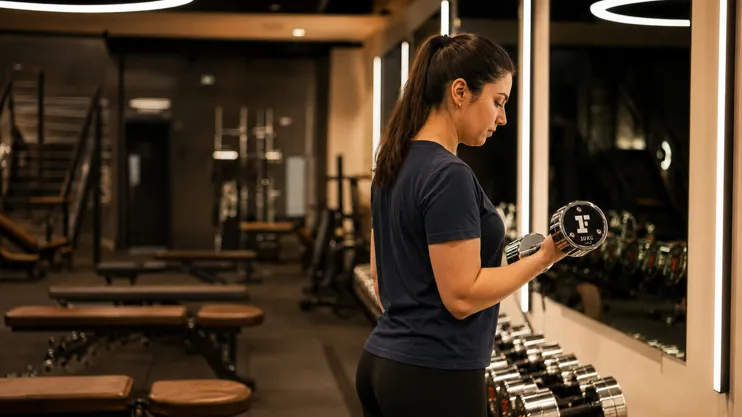
How to start strong and progress stronger
When you’re starting out with strength training, asking “what weight should I be lifting?” is one of the simplest (and most reasonable) questions you can come to us with.
Sadly… the same can’t quite be said for the answer.
We’d love to be able to say there are hard and fast rules to master, but the fact is the variables make that almost impossible. Your goal, your experience level, the specific exercise, the muscle group you’re targeting… they all need factoring in.
But don’t worry… that’s not to say we can’t get you feeling more confident about it. Because there are at least a few gym floor-friendly hacks we can offer that will make sure you neither overdo it… or underestimate yourself.
How to find your starting weight
If you’re eyeing up what everyone around you is lifting or worried about what they’re going to think, first step? Don’t. We’ve trained long enough to say that it’s true when they say nobody cares (sorry) and the only thing you should think about is what’s right for you.
The right starting weight is the one that challenges you without affecting your form – and for beginners, that usually means starting much lighter than seems necessary.
How do you know when you’ve found that sweet spot?
Pick up a weight you reckon you can handle for your target number of reps and do your first set. Can you have managed 2-3 more reps… just? That’s about right. Trembling and losing technique before the end means you’ve gone too heavy. Finish with ten reps in the tank and zero drama, you’ve landed too light.
The last-few-reps rule of thumb
When it comes to gym, reaching failure’s a good thing. That’s why the last two or three reps of your set should feel (genuinely) hard. We’re not talking dangerous, vein-popping or compromised form… just the need to dig deep on the effort scale. It’s that element of challenge that tells your muscles to adapt and grow stronger. Too easy and you’re not creating enough stimulus. Too heavy and your form will slip and you’ll risk getting injured.
Start lighter than you think
Repeat after us: there is no shame in picking up the lightest dumbbell on the rack. Every experienced lifter starts out somewhere – and you’ll enjoy your strength journey much more when you’re not throwing your back out.
If (like many beginners) you’re tempted to start out heavy, just trust us on this one. Starting lighter will give you the chance to perfect the movement pattern properly before adding load – and if you can crack technique early on? That’s your ticket to better gains for as long as you train.
Let the data tell you
If you’re not sure where your baseline actually is, able's Strength Test takes the guesswork out entirely - testing your strength across key movements to establish your Strength BioAge and give you a precise starting point for every exercise. It's the most accurate way to know exactly what you should be lifting from day one. [Find out more about able.]
What dumbbell weight should I use?
As you might have guessed by now, there’s no single number – it very much varies depending on exercise and muscle group. For example, your legs are naturally much stronger than your biceps – so the weight you use for a goblet squat will be completely different to what you might use for a curl.
To start with, use the last-few-reps rule. Then once you’ve got a few sessions under your belt and have a feel for what you can handle, look for an online weightlifting calculator for guidance on what you should be lifting for your weight – and how to progress.
Or if you want something much more accurately tailored and can bring an expert eye to every lift? Perhaps consider a Personal Trainer to help you work out specific (and safe) targets based on your goals.
What weight should I lift for my goal?
Speaking of goals, getting specific on what you want to achieve is an essential part of nailing down the right rep ranges and weight.
To build muscle
Aim for 6-12 reps per set. The weight should be challenging enough that the last few reps require real effort. This is the rep range most strongly associated with muscle growth – enough volume to create a growth signal and enough load to do meaningful work.
To build strength
You want lower reps, heavier weight. Working in the 3-6 rep range with heavier loads trains your nervous system to recruit more muscle fibres and lift more efficiently over time. This is less about size and more about pure capability.
For general fitness
If you're not chasing a specific goal and just want to get fitter and feel stronger, a moderate rep range of 8-15 works well. Slightly lighter, slightly more reps – and a great place to start before you narrow your focus.
How do I know when to go heavier?
When those last few reps stop feeling quite so challenging, that’s your cue to level on up.
It doesn’t have to be a huge leap to make a difference (are we spotting a pattern here…?) A small, incremental increase will do the job nicely. Rep ‘til they become too easy, then rinse and repeat.
This principle of adding load gradually over time is what we mean when we say ‘progressive overload’ – and it’s the engine that drives any meaningful strength progress.
So, a good rule of thumb? When you can blaze through all your target reps with solid form and could keep on going – that’s your sign to increase the weight next time.
…about the bench press
“How much should I bench press?” is one of the most searched questions in strength training… and also one of the least easy to answer with a straight number.
Bench press strength varies massively because of a number of considerations – body weight, training history, arm length, chest development – meaning there will never be a one-size-fits-all way to advise.
That being said, a good place to start as a beginner is simply with a bar (which is usually around 20kg) and add weight gradually. When you find a load that challenges you in the 8-12 rep range with beautiful form, you’ve found your baseline.
Remember – like with any exercise at this stage, it’s really not about chasing the numbers. Building a movement pattern safely and developing a solid foundation to progress from is a flex that far outlasts any ego glow.
Get the right weight for you at Fitness First
So, you can probably see what we mean about these being no single clear-cut answer. But luckily there’s lots of other ways we can provide support as you get your strength journey underway.
Try a trainer
Our personal trainers can assess your current strength, show you how to find your working weight across different exercises and build a plan that progresses you safely over time. Find a personal trainer.
Pick a class
Prefer to learn in a group setting? Our strength classes are a great environment to get comfortable with weights under qualified coaching. Browse strength classes.
Check out able
And if you want a fully personalised programme that adapts as your strength develops (including BioAge tracking to measure what's changing under the surface) check out able – our personalised smart gym system. Find out more about able.
Finding the right weight might not be easy, but choosing the right place to make real progress definitely is.
Published: 25 September 2026 Last Updated: 25 September 2026