Loved by athletes, hyped by techies – but is it the recovery routine for you?
Kicking back for a nice relaxing lie-down? In the gym? That’s a waste of precious repping time, surely…
Whether you’re new to recovery or have already seen the light, it’ll be hard not to be at least a little curious about the red light therapy gear taking over the fitness world. Embraced by elite athletes and high-performance pros for years, the case for this recovery tech has been building ever since NASA first used it to heal wounds during space expeditions towards the end of the last century.
But assuming your needs are a little more down to earth, how can red light therapy enhance your own recovery routines? Let’s take a look.
What is red light therapy?
Red light therapy (or RLT) is a non-invasive treatment that uses specific wavelengths of red and near-infrared light to penetrate the skin and stimulate cellular function.
While it might sound intense, it’s completely painless – and needs no downtime to rest your body after. Because technically, it is the rest.
The whole process works on a cellular level with the light being absorbed by your mitochondria – aka the structures inside your cells that generate energy and support your recovery. This helps to kickstart cellular repair, lower inflammation and get your blood flowing better – all of which helps your body to heal.
We’re not just talking skin-deep benefits either. While it does help to improve skin health, boost collagen and repair wounds, it also promotes recovery and pain relief for muscles and joints, as well as better sleep, mood and management of chronic health conditions.
Does red light therapy actually work?
The evidence is certainly growing.
An in-depth piece in New Health Journal in 2025 explored a wide range of believed benefits, noting that “Major medical and academic sources generally describe red light therapy (photobiomodulation) as an emerging but legitimate modality with promising evidence in certain areas - while also emphasising that results vary, protocols are inconsistent, and marketing often runs ahead of the science.”
That may be true, but the science that is available is pretty compelling.
For skin health, a controlled study found that those receiving red light therapy showed significantly better outcomes across skin texture, firmness and collagen density than those who went without – with both red-spectrum-only and broader wavelength combinations proving effective.
For muscle recovery, a 2015 meta-analysis of 16 randomised controlled trials by Leal-Junior et al. found that photobiomodulation improved exercise performance and post-exercise recovery markers. (While a 2018 systematic review by Vanin et al. went on to confirm that it improves muscle performance and reduces fatigue in healthy individuals – with benefits observed both when used before exercise and after.)
Where it comes to things like acne, eczema and some chronic pain conditions, the evidence is still lagging behind a little. A 2024 Cochrane review (considered the ultimate in evidence-based medicine) found no high-certainty evidence that red light therapy treated acne, though it noted that some studies showed promise.
So until the science comes through with the hard proof, it's always worth knowing the difference between what's well-supported and what's still emerging. We don’t mind hitting the therapy bed while we wait, though…
What are the red light therapy benefits?
Caveats covered, here's what the current evidence most strongly supports so far:
Skin health and collagen production
The skin benefits of red light therapy are by far the most applauded. It’s all down to evidenced fibroblast activity (fibroblasts are the cells in the dermis responsible for producing collagen and elastin. )
Research has shown that red and near-infrared light stimulates these cells, increasing collagen synthesis. A 2003 study in the Journal of Photochemistry and Photobiology provided early laboratory evidence of this, demonstrating that near-infrared light could stimulate collagen production in human fibroblast cultures.
Clinical studies have since supported this finding, with tests run over eight to twelve weeks showing measurable increases in intradermal collagen density as well as visible reductions in fine lines and skin roughness.
Muscle recovery and reduced DOMS
As those previously cited studies showed, red light therapy can shorten recovery time between workouts and reduce the muscle soreness that follows intense training by improving mitochondrial energy production and reducing oxidative stress.
Inflammation and pain reduction
One of the more established applications of red light therapy is its role in managing pain and inflammation. By reducing inflammatory markers and promoting improved circulation to affected areas, photobiomodulation has shown benefits for a range of musculoskeletal conditions – including joint stiffness, arthritis and lower back pain. It follows the same principle as with recovery: light energy stimulates cellular repair at the tissue level, which over time can reduce swelling and improve mobility.
Who is red light therapy suitable for?
The good news is that most people can use red light therapy safely, making it a highly accessible recovery tool to work into your routine.
Despite the bed-style tech looking like it belongs in a tanning salon, it produces no UV radiation – so it won’t darken or damage the skin and has a strong safety profile across the research literature.
After a heavy workout, a session in a red light bed can be really comfortable and relaxing way to speed up recovery between training.
But it's particularly well-suited to:
-
People looking to support skin health and reduce visible signs of ageing
-
Anyone dealing with muscle soreness, joint discomfort or inflammation
-
An addition to an existing recovery routine
Of course, there are some situations where caution is advised. If you're pregnant, taking medications that increase light sensitivity, or have active cancerous lesions, it's worth checking with a healthcare provider before starting. These situations aside, red light therapy is considered safe for the vast majority of people.
What does a session look like?
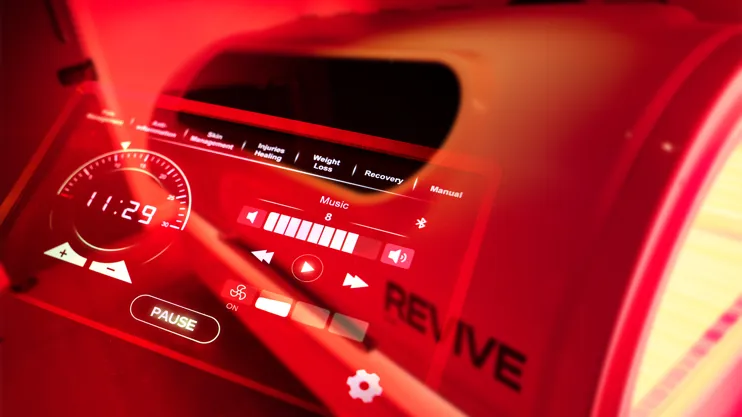
You’ll usually see sessions taking place in a full-body red light bed, which allows you to lie comfortably while the light works across your whole body at once. Unlike a tanning bed, there's no heat, no UV radiation and no sensation beyond a gentle warmth – which many people find highly relaxing.
A session typically lasts between 10 and 20 minutes. You'll want to use it consistently to see the best results, and it’s recommended you take regular sessions over several weeks if you want to feel the full benefit.
At Fitness First, we're proud to bring this next-level wellness experience to our members in a couple of different ways. At our Highbury club, members have access to a dedicated Red Light Therapy Room - a purpose-built space for your standalone recovery sessions.
Across select clubs, we also offer red light therapy as part of our timetabled class programme, with three distinct formats:
Recovery Red Light Therapy: a guided standalone recovery session
Yoga Red Light Therapy: which pairs red light with the restorative benefits of yoga
Pilates Red Light Therapy: combining intentional movement with the power of light therapy
Looking for red light therapy near you? Find your nearest Fitness First club here.
What results can I realistically expect… and when?
Red light therapy before and after results vary by person and goal, but here’s some of the changes our members typically notice:
Muscle recovery: many people notice reduced soreness and faster recovery within the first few sessions, particularly when used after intense training.
Skin health: visible improvements in texture and firmness typically emerge after four to six weeks of consistent use, with more significant changes in collagen density over three months or more.
Pain and inflammation: results vary by individual and condition, but some improvement in comfort is often reported within the first few weeks of regular sessions.
So, ready to give red light the green light in your recovery routine? Find out more about red light therapy at Fitness First.
Published: 25 September 2026 Last Updated: 25 September 2026