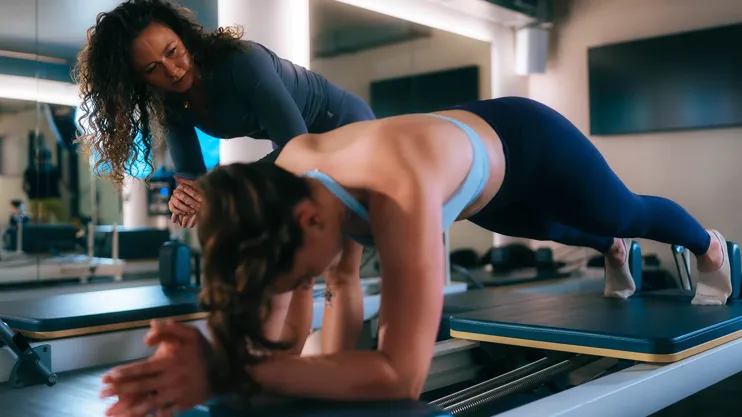
Meet the full-body workout that’s taken over the fitness world
If you’ve heard the name, you’ve definitely seen the hype – but what IS Reformer Pilates, exactly? Rising to popularity through the ‘boutique studio boom’ of the last decade, this kit-enhanced take on classic Pilates classes, designed around a specialist machine called a Reformer.
Curious? You should be. According to fitness booking platform ClassPass, Pilates was the top-booked workout of 2025, with 15 million reservations and Reformer coming in as global favourite format (a huge +71% year on year growth)
Impressive, by anyone’s standards. But is it something you should try? What’s so great about it anyway? And most importantly… which Fitness First club will you try it in?
Read on to find out…
Where did Reformer Pilates come from?
Did you know Pilates gets its name from a guy called Joseph? Yes, Joseph Pilates came up with his eponymous fitness method in the early 20th century. Having spent much of his childhood unwell, his life’s mission became dedicated to making himself healthy and strong – which is how he ended up creating a new exercise technique blending both Eastern and Western principles.
The Reformer element finds its origins in World War I, when springs were attached to injured soldiers’ hospital beds to help them build their strength and mobility during rehabilitation. And so, the first ‘Pilates Reformer bed’ was born – the theory of which still stands today.
Today’s machines consist of a sliding carriage mounted on a frame, attached to a system of springs, straps and a foot bar. The springs provide adjustable resistance that can either support or challenge movement – making it suitable for levels ranging from complete beginner to experienced athlete.
Unlike its mat-based counterpart, Reformer adds a dynamic element to bodyweight workouts as the moving carriage demands constant engagement of stabilising muscles, improving balance, coordination and control – as well as strength.
Better still, exercises can be performed from a range of positions – lying, sitting, kneeling, standing… all of which means you get a full-body workout in every single session.
What is a Reformer Pilates machine?
If your first look at a reformer machine makes you want to head straight for the door, don’t worry. You’re not the only one. But while it might give a strong medieval torture device vibe, it’s not as complex (or evil) as you think it is.
Let’s demystify it for you:
The carriage: this is the padded platform that slides smoothly along the frame – and where you’ll position yourself for most exercises.
The springs: attached between the carriage and the frame, these provide the resistance. More springs mean more resistance, while fewer springs create a lighter, but sometimes more challenging load – depending on the exercise.
The footbar: bar at one end of the frame used to push or pull the carriage using your feet or hands.
The straps: long straps with loops at the end, used for upper body and leg exercises where you pull or push against resistance.
The genius of the design is its versatility. The same machine that a complete beginner uses for a supported introductory session is the same machine an elite athlete uses for advanced strength and power work – just with different spring configurations and exercise variations.
What are the benefits of Reformer Pilates?
More than you’d probably expect from a low-impact workout.
In fact,the evidence base for Pilates is growing steadily. A 2025 narrative review of Pilates research published across 2024 found consistent evidence for improvements in balance, flexibility and strength, as well as reductions in pain, fatigue and sleep problems across multiple conditions. And that’s just for starters.
Here's what the research most strongly supports:
Core strength and stability
The reformer's sliding carriage demands continuous engagement of the deep stabilising muscles of the core – aka, the muscles that support your spine and pelvis in everyday movement. This is what gives Reformer Pilates its reputation for building functional strength that translates beyond the studio.
Posture and alignment
By targeting the muscles responsible for spinal support and body awareness, Reformer Pilates has been shown to produce meaningful improvements in postural alignment. For example, a 2025 study published in BMC Sports Science and Medicine Rehabilitation found significant improvements in postural alignment in office workers following a Reformer Pilates programme.
Flexibility and mobility
The controlled resistance of the springs allows muscles to be strengthened through a full range of motion – which is one of the key advantages over conventional resistance training. Improved flexibility and joint mobility are among the most consistently reported outcomes across the research.
Rehabilitation and injury prevention
The non-weight-bearing position on the carriage makes Reformer Pilates particularly valuable for people recovering from injury or managing chronic musculoskeletal conditions. A 2024 randomised controlled trial found Reformer Pilates produced significant improvements in pain intensity, fatigue and sleep quality in people with chronic musculoskeletal pain.
Research has also found that equipment-based Pilates is more effective than mat Pilates for reducing pain and disability in people with lower back conditions.
Mental health and wellbeing
The 2025 narrative review found that Pilates exercise was consistently associated with reduced depression, improved cognitive flexibility and better quality of life – all benefits that go well beyond the physical.

Who is Reformer Pilates for?
One of the most compelling things about the reformer is how genuinely inclusive it is. The spring system can be adjusted to make exercises more supported or more challenging – which effectively means the same class can work for a complete beginner, someone recovering from injury and an experienced athlete… all at the same time.
It's particularly well-suited to:
-
Beginners: the machine provides a level of support that makes learning movement patterns much easier than on a mat
-
People recovering from injury: the non-weight-bearing carriage allows strength to be rebuilt without piling pressure on injured joints
-
Athletes and active people: as a cross-training tool, it builds functional strength, flexibility and stability that supports performance in other training
-
Anyone with postural issues or desk-based work: the focus on deep stabilising muscles and spinal alignment addresses many of the patterns that sedentary work creates
-
People managing chronic conditions: including lower back pain, where the evidence for equipment-based Pilates is especially strong
What to expect from a Reformer Pilates class
A typical Reformer Pilates session lasts 45 to 60 minutes. You'll work through a structured sequence that usually moves through the whole body: lower body, upper body, core and a cool-down with mobility work.
First timer? No problem. Your instructor will be there to guide you through each exercise, adjusting spring settings and offering modifications based on your level.
We recommend wearing fitted clothing that allows freedom of movement, and most importantly, don’t forget your grip socks. You’ll find that most studios require them for safety and hygiene.
At Fitness First, you can try out Reformer Pilates across our four class formats, each with a different focus. Find your best fit on the links below:
Reformer Pilates results - when will I see them?
After the crazy levels of sweat subside, most people tend to notice a difference in how they feel within the first few sessions.
You might start noticing improved awareness of posture, and a sense of having worked muscles you don't normally reach. Visible and measurable improvements in strength, flexibility and stability usually begin to emerge after eight to twelve weeks of consistent practice.
Whether you're looking to build strength, move better, recover from injury or simply find a workout that challenges you without wrecking you – Reformer Pilates has something to offer.
And at Fitness First? You've got four ways to try it.
Joined the Reformer Pilates Power class this week and I’m honestly obsessed! The instructor was amazing explaining every movement so clearly and helping me perfect my form. I could really feel my core working throughout, and it was such a good mix of challenge and control. My body already feels stronger and more aligned after just one session. Can’t wait to book my next one!
Sophie, London Bridge Cottons
Published: 23 September 2026 Last Updated: 23 September 2026